
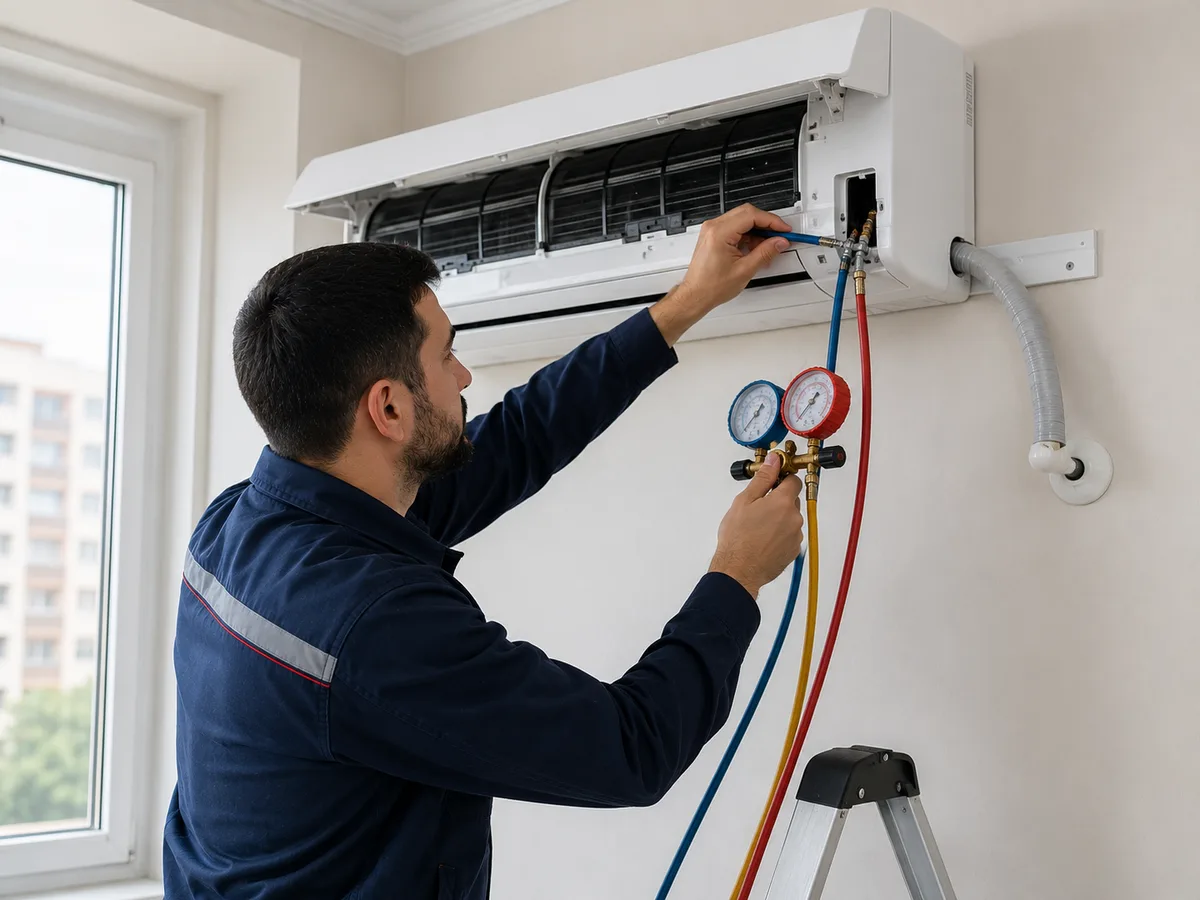
After a new air conditioner is installed, users often ask the same question: “The air conditioner is running, so why is it not cooling?” Many people immediately assume that the problem is caused by low refrigerant. However, weak cooling in a recently installed air conditioner may be caused by installation errors, incorrect electrical connections, or improper device settings.
First, make sure the correct operating mode is selected on the remote control. The air conditioner should be running in Cool mode, the snowflake icon should appear on the display, and the temperature should usually be set between 22–24°C. Sometimes the appliance is accidentally set to Fan, Dry, or Auto mode, which prevents the room from reaching the desired temperature.
Failure to vacuum the system during installation is one of the most common problems. Air and moisture left inside the copper pipes interfere with the normal operation of the cooling system. This reduces efficiency and may eventually damage the compressor. During professional installation, the system must be vacuumed using a dedicated vacuum pump.
A refrigerant leak may also cause a newly installed air conditioner to stop cooling properly. If the pipe connections are not tightened correctly or the flare connections are poorly prepared, refrigerant may escape. In this situation, the air conditioner continues to run but cannot lower the room temperature effectively. Ice forming on the pipes or weak cooling may indicate refrigerant loss.
The length of the copper pipes and the way they are installed are also important. If the pipework is too long, sharply bent, or poorly insulated, cooling efficiency decreases. Damaged pipe insulation may also cause energy loss and condensation problems.
Incorrect placement of the outdoor unit can affect performance as well. If the outdoor unit is installed in a poorly ventilated area, exposed to direct sunlight, or surrounded by insufficient airflow, heat cannot be released properly. As a result, the air conditioner runs longer but provides weaker cooling.
Electrical connection errors may also cause problems. Low voltage, the use of an undersized electrical cable, or an incorrectly selected circuit breaker can prevent the compressor from operating at full capacity. For this reason, a dedicated electrical circuit is recommended for the air conditioner.
In some cases, the problem may be related to the temperature sensor or electronic control board. If the sensor measures the room temperature incorrectly, the compressor may shut down too early. If the control board is faulty, the appliance may not manage the cooling mode correctly.
Incorrect installation of the drainage line can also cause additional issues. If the drain hose is installed in the wrong direction or becomes bent, water may drip from the indoor unit. Although this does not always directly affect cooling, it may indicate poor installation quality.
Pay attention to the following warning signs: the air conditioner runs but does not blow cold air, ice forms on the pipes, the outdoor unit does not start, water drips from the indoor unit, unusual noises are heard, or there is a burning smell. Do not continue using the appliance in these situations. Installation errors that are not corrected in time may lead to more serious and expensive faults.
If your air conditioner does not cool properly after installation, you can contact a professional air conditioner technician through Ustamvar.az. The technician will inspect the system on-site, check the installation, refrigerant level, vacuuming quality, electrical connection, and the appliance’s main components. Once the cause of the problem has been identified, you will be informed in advance about the required work and cost.