
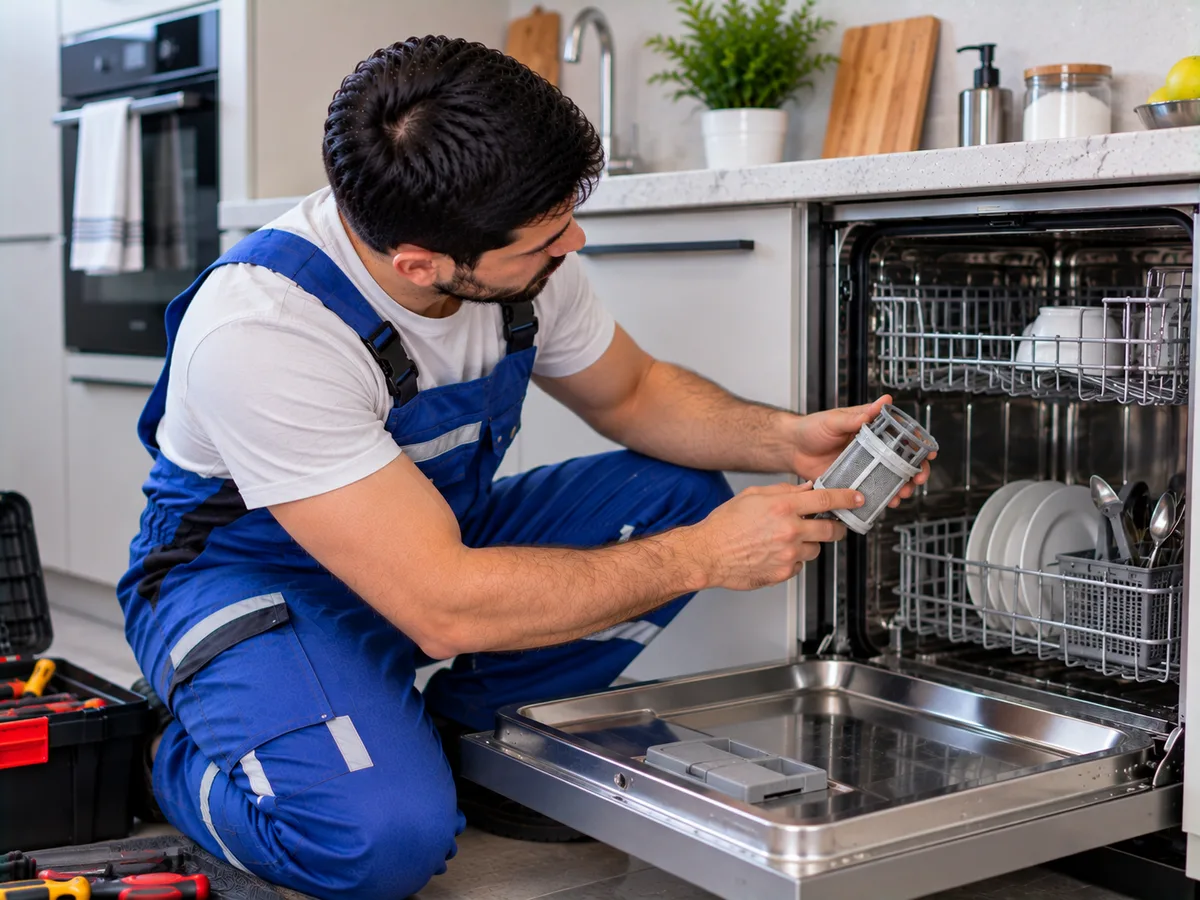
A dishwasher is one of the appliances that helps save time with everyday household tasks. However, because water, electricity, heating, and electronic control systems work together, various faults can occur. Replacing parts without correctly identifying the cause of the problem can lead to additional expenses and recurring faults.
The first stage of dishwasher repair is correctly identifying the symptoms of the fault. If the appliance does not start at all, does not fill with water, does not drain, does not clean dishes properly, or stops the program halfway through, these symptoms may indicate problems with different components.
If the dishwasher does not start at all, the electrical connection should be checked first. The power outlet, electrical cable, circuit breaker, and whether the appliance is receiving power should be considered during the initial inspection.
If power is available but the appliance does not start, the door lock and microswitch should be checked. If the dishwasher does not detect that the door is fully closed, it may not start the wash program for safety reasons.
If the electronic control buttons and display are working but the program does not start, there may be a fault with the control module, door lock, water inlet system, or other safety sensors.
A dishwasher not filling with water is one of the most common problems. In this case, the water supply valve, inlet hose, inlet filter, and water pressure should be checked.
A kinked or blocked inlet hose can restrict water from entering the appliance. The small filter located at the hose inlet can also become clogged with dirt and deposits.
If the water supply is normal but the dishwasher still does not fill with water, there may be a problem with the inlet valve. This electrically controlled valve opens when the program starts and allows water to enter the appliance.
Some dishwashers use an AquaStop system. If a water leak is detected or a problem occurs with the AquaStop mechanism, the system may stop the water supply for safety reasons.
If the dishwasher fills with water but does not clean dishes properly, the filter and spray arms should be checked first. Grease and food residue accumulated in the filter can reduce water circulation.
When the holes in the spray arms become clogged, water cannot reach the dishes with sufficient pressure. As a result, food and grease residue may remain on the dishes even after the program has finished.
Loading dishes too tightly into the baskets can also reduce washing performance. Large dishes should not prevent the spray arms from rotating or block water from reaching other dishes.
The type and amount of detergent used also affect washing results. Unsuitable detergent, a tablet that does not dissolve completely, or a detergent dispenser that does not open can cause dishes to remain dirty.
Failure to heat the water is another common dishwasher fault. When the water does not reach the required temperature, removing grease from dishes becomes more difficult, and drying performance may also decrease.
The heating element, temperature sensor, and electronic control system are involved in heating the water. If one of these components develops a fault, the program may continue using cold or insufficiently heated water.
The temperature sensor sends information about the water temperature to the control module. If the sensor sends incorrect readings, the heater may not be switched on or off correctly.
If the dishwasher does not drain water, the drainage system should be checked. Blockages in the filter, drain pump, drain hose, or sewer connection can prevent water from leaving the appliance.
If a piece of glass, food residue, or another foreign object enters the drain pump, the pump impeller may become blocked. The pump may attempt to operate, but the water may not drain completely.
A kinked or blocked drain hose can also cause drainage problems. Therefore, it is important to inspect the entire water outlet line before replacing the pump.
If the dishwasher stops the program halfway through, this does not necessarily mean that the electronic control board is faulty. Weak water supply, a heating problem, drainage fault, sensor error, or poor contact in the door lock can also cause the program to stop.
If the appliance repeatedly stops at a particular stage of the program, identifying the exact stage at which the problem occurs can make diagnosis easier. For example, stopping after filling with water and stopping during the draining stage can indicate completely different problems.
Water leaking from a dishwasher is a problem that should be taken seriously. The source of the leak may be the door seal, hoses, pump connections, water inlet components, or internal pipes.
If water appears from underneath the door, the problem is not always caused by the door seal. Excessive foaming, improper appliance leveling, or a damaged spray arm can also direct water toward the door.
When water collects underneath the dishwasher, some models activate a leak sensor. In this situation, the appliance may stop filling with water, run the drain pump continuously, and display an error code.
If the dishwasher makes unusual noises while operating, it is important to determine at which stage of the program the noise occurs. Noises during water intake, washing, or draining can have different causes.
A loud humming or mechanical noise during washing may be related to the circulation pump, spray arms, or a foreign object remaining inside the appliance.
If a loud noise occurs during draining, the drain pump should be checked for foreign objects or mechanical wear.
If the dishwasher cleans the dishes but does not dry them properly, the drying system, heating process, rinse aid level, and selected program should be considered. Some programs may provide less effective drying.
White spots on dishes do not always indicate an appliance fault. Water hardness, salt and rinse aid settings, detergent type, and dosage can also affect the results.
An unpleasant smell from the dishwasher is often associated with food residue remaining in the filter, drainage area, and on internal surfaces. Regular cleaning can help prevent such problems.
If an error code appears on the dishwasher display, it can provide useful information for diagnosis. However, the meaning of the same error code may vary depending on the brand and model.
Immediately replacing a specific component based only on an error code is not the correct approach. The code usually indicates the area of the system where a problem has been detected, while additional checks are required to identify the actual faulty component.
Proper diagnosis should begin with the information provided by the customer about the fault. It is important to consider when the problem started, at which stage the appliance stops, whether an error code appears, and what repairs or interventions have previously been performed.
The appliance should then be visually inspected. Water leaks, burnt contacts, damaged cables, loose connections, clogged filters, and other visible problems can make diagnosis faster.
Appropriate measuring instruments should be used when checking electrical components. The condition of the heater, sensor, valve, pump, and other electrical components cannot be reliably determined by visual inspection alone.
It is not advisable to conclude that the electronic control board is faulty before checking the other main components. Sometimes the control board is functioning correctly, but an incorrect signal from a sensor, wiring, door lock, or another component can stop the appliance from operating.
When repairing a dishwasher, it is important that any replacement part is compatible with the appliance's brand and model. Parts that look similar may have different electrical ratings and technical specifications.
Before beginning the repair, the cause of the fault and the required work should be determined as clearly as possible. This helps prevent unnecessary part replacements and additional expenses.
When choosing a dishwasher repair technician, the decision should not be based only on the repair price. The technician's experience with dishwasher repairs, diagnostic approach, and ability to explain the required work in advance should also be considered.
A professional dishwasher repair technician should first try to identify the cause of the fault rather than immediately replacing a component. For example, in the case of a drainage problem, the filter, hose, and drain connection should be checked before replacing the pump.
During the repair, it is useful to ask the technician which component is faulty, why it needs to be replaced, and what caused the problem.
If a replacement part is installed, its compatibility with the appliance should be confirmed, and where possible, it should also be clarified whether a warranty is provided for the work performed.
After the repair is completed, the dishwasher should not simply be switched on; it should be tested using an appropriate program. Water intake, washing, heating, drainage, and possible leakage should all be checked.
Proper use of the dishwasher can reduce the likelihood of certain faults. Regularly cleaning the filter, checking the spray arms, and using detergent suitable for the appliance are important.
Removing large food residues from dishes before loading them can help prevent the filter and drainage system from becoming clogged too quickly.
If the same error occurs repeatedly or there is a problem involving electricity, water leakage, heating, or electronics, it is not recommended to interfere with the internal components without the necessary technical knowledge.
Because a dishwasher operates with both water and electricity, safety is particularly important during repairs. The appliance should be disconnected from both the power supply and water supply before internal components are inspected.
Proper diagnosis is one of the most important stages of dishwasher repair. By evaluating the fault symptoms, error codes, water and electrical systems, pumps, sensors, and electronic controls together, the cause of the problem can be identified more accurately.
If the dishwasher does not start, does not fill with water, does not clean dishes properly, does not heat the water, stops the program halfway through, or leaks, it is advisable to contact a professional dishwasher repair technician. Proper diagnosis and appropriate repair can help reduce the risk of the fault recurring.